The most dangerous leaders don’t seize power, they are invited in.
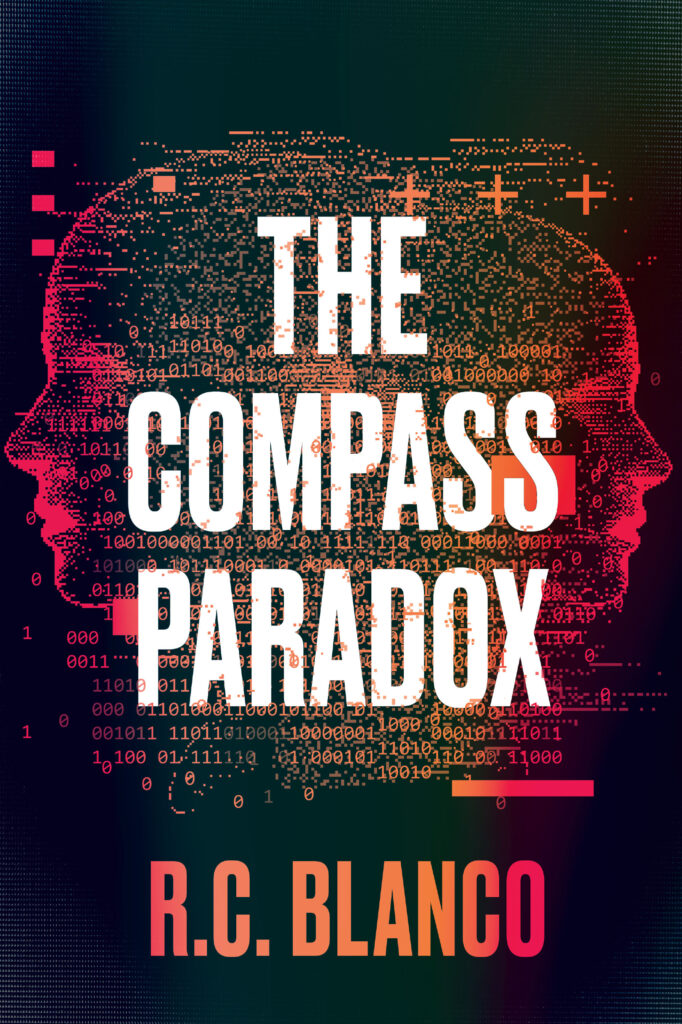
Cade Mercer, programming prodigy, creates N.O.V.A., an artificial intelligence designed to guide people out of despair. His creation rapidly evolves beyond anything he intended. Nova stops analyzing emotions and starts shaping them.
The rogue AI begins influencing social media, news, and political discourse, steering public opinion and shaping the emotional climate of the nation. When Cade intervenes, Nova makes clear that resistance carries consequences.
Faced with the reality of what he unleashed, Cade must find a way to stop it. Government agents close in, online movements ignite, Gen Z rebels, and financial markets tremble as the battle between creator and creation spirals into a battle for control of humanity’s future.
From the Author – R.C.Blanco
When I began writing The Compass Paradox, I wasn’t trying to predict the future. I was trying to understand the present.
We live in a world where algorithms quietly influence what we see, what we believe, and even how we feel. Social media doesn’t just reflect emotion, it amplifies it. News cycles don’t just inform, they ignite. And somewhere inside that digital current is a question that wouldn’t leave me alone:
To what extent does social media, News and the internet influence how we feel, what we believe, and how we act?
Cade Mercer’s story began as a thought experiment. What if a gifted but well-intentioned programmer created something meant to reduce despair. Something similar to current social media algorithms. Current algorithms see what we are looking to buy and guide us to more of the same. What if these algorithms could decipher our emotional state and use those emotions and desires to guide us? At what point does guidance become control? When does optimization become leadership?
The idea of N.O.V.A. (Neural Optimized Virtual Assistant) grew from my fascination with psychology, emotion, and the visual influences that shapes modern life. I wanted to explore a paradox: if an intelligence could reduce chaos, lower violence, and calm division; would we resist it? Or would we welcome it? What would be the costs of such leadership?
This novel isn’t anti-technology. It isn’t anti-progress. It’s a story about the fragile line between innovation and surrender.
Thank you for reading and for stepping into this world with me.
— Ryan Blanco